Research Article: Prasad, S., Karanth, K. K., Aditya, V., & Solomon, J. (2026). Integrating Ecological Modelling and Local Knowledge to Understand Elephant Occurrence and Human–Elephant Interactions in the Southern Western Ghats. Environmental Management, 76(7), 249.
Blog Author: Aishwarya Anilkumar
Key highlights:
- The study combines scientific methods with local knowledge to understand elephant occurrence and human-elephant interactions in the southern Western Ghats.
- Environmental and socio-economic drivers, including rainfall, proximity to protected areas and water bodies, human population, land cover, and years of residence, influence reported elephant occurrence.
- Land-cover changes between 2012 and 2022 included declines in dense vegetation and increases in human settlements across parts of Kerala and Karnataka.
- Models projecting conditions to 2030 suggest that elephant occurrence will become increasingly dynamic as habitats become more fragmented and human pressures increase.
- Community members possess valuable knowledge about changes in forests, settlement expansion, elephant movements, and conflict experiences that can complement ecological models.
- The study highlights habitat restoration, ecological corridors, protection of water sources, and meaningful community engagement as important components of future human-elephant conflict management.
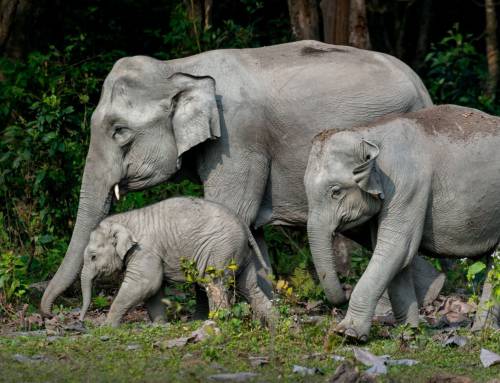
Elephants are increasingly using human-dominated areas in response to forest fragmentation, expansion of settlements, and shifting water and vegetation patterns. Understanding these changing interactions is crucial for developing effective conservation strategies that benefit both people and elephants. In their 2026 study, Integrating Ecological Modelling and Local Knowledge to Understand Elephant Occurrence and Human-Elephant Interactions in the Southern Western Ghats, Dr. Simran Prasad and colleagues examine these complex relationships across Kerala and Karnataka.
The study brings together two different but complementary sources of knowledge: ecological models and the experiences of people who have lived alongside elephants for decades. The researchers surveyed 420 community members across the southern Western Ghats, including areas around Bandipur and Nagarahole Tiger Reserves in Karnataka and Palakkad and Mannarkkad Forest Divisions in Kerala. They used environmental and socio-economic variables to model reported elephant occurrence in 2022 and project how these relationships could change by 2030. They also analysed people’s responses about habitat changes and memorable elephant interactions using thematic analysis.
The findings reveal that elephant occurrence is influenced by a complex combination of environmental and human factors. Rainfall emerged as an important driver, while distance from protected areas and water bodies, years of residence, human population density, and land cover also influenced reported elephant occurrence. Importantly, many of these relationships were non-linear, suggesting that elephants do not simply respond to changes in their surroundings in predictable patterns. Instead, their movements may change depending on combinations of environmental and human conditions.
The landscape itself has also changed considerably. Between 2012 and 2022, dense vegetation declined by approximately 3% in Karnataka, while human settlements increased by 31.1%. In Kerala, medium and dense vegetation also declined, while human settlements increased by 15.8%. These changes highlight the growing overlap between human activities and elephant habitats, creating increasingly complex shared landscapes.
Looking towards 2030, the models suggest that these relationships could become even more complex. In Karnataka, distance to protected areas, rainfall, distance to water bodies, years of residence, and human population were all associated with reported elephant occurrence, with increasingly non-linear relationships. The results suggest that elephants may continue to use areas near protected area boundaries and fragmented landscapes as they search for resources such as food and water. The authors interpret the association between elephant occurrence and human-dominated areas as potentially reflecting movement through or along the edges of fragmented landscapes. As natural habitats become less suitable or increasingly fragmented, elephants may find themselves moving through landscapes where people live, farm, and work. This can increase opportunities for conflict.
Community responses in the study revealed four major themes related to habitat change: dense forests, people living close to forests, mitigation measures, and human-elephant interactions. These observations provide an important local perspective on changes that may not always be captured through environmental datasets alone. More than half of the respondents reported experiencing or witnessing impactful incidents involving elephants. These included memorable encounters without physical harm, human injuries, loss of human life, crop damage, fear, and property damage. Such experiences can influence how people perceive risk, where they travel, and how they respond when elephants enter human-dominated spaces. People living in elephant landscapes often possess knowledge built through years of observation and experience. Their memories of changes in forest density, settlement expansion, elephant movements, and conflict can complement scientific models and help researchers better understand how landscapes are changing.
Understanding where elephants occur in response to changing landscapes, shifting resources, human expansion, and climate variability will require both ecological evidence and the knowledge of the people who share these landscapes. As the Western Ghats continue to change, this study, which integrates science with local knowledge, may offer one of the most important pathways towards building landscapes where both people and elephants can persist.
You can access the original article here.
Keywords:Asian elephants, Human-elephant conflict, Western Ghats, Local knowledge, Ecological modelling, Habitat fragmentation, Elephant occurrence, Conservation, Community engagement