Research Article: Siddiqui, I., Basu, N., Bandyopadhyay, K., Koprowski, J. L., & Angandhula, V. Could prey support the recovery of a tiger population? Long-term prey density and carrying capacity assessment of a tiger reserve in India. Oryx, 1-9.
Blog Author: Yashendu C. Joshi
Key highlights:
- Prey abundance is a critical determinant of tiger population recovery. However, the viability of tiger populations depends not only on the abundance of a single prey species but also on the diversity and stability of ungulate communities.
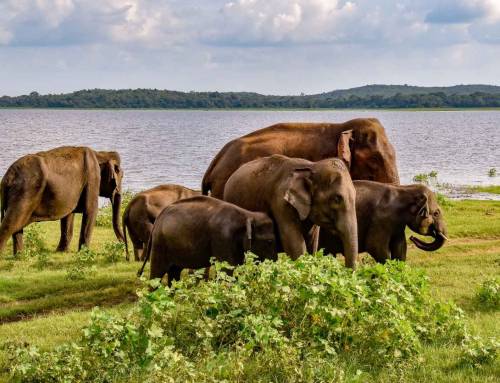
- The study uses a long-term data set to estimate changes in prey populations (chital, sambar, nilgai, wild pig and chousingha) in Kawal Tiger Reserve in Telangana.
- Chital populations have increased, while nilgai, sambar and chousingha populations remained stable, and wild pig populations fluctuated considerably.
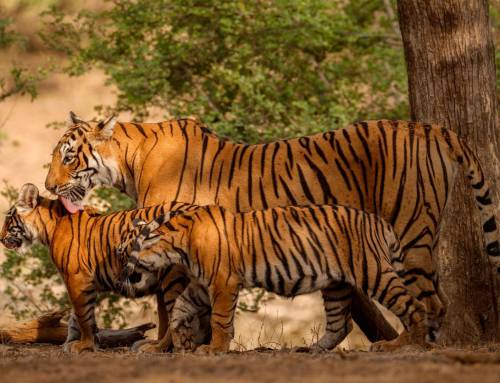
- Based on the estimated ungulate populations, the Kawal Tiger Reserve can potentially support 35-41 tigers, highlighting the reserve’s capacity to sustain a recovering tiger population.
One of the most important concerns regarding large carnivore recovery is availability of prey populations. Focusing on Kawal Tiger Reserve in Telangana, this study examines a decade of systematic data (2010-2022) to evaluate long-term trends in ungulate prey populations and to estimate whether the landscape can realistically support a recovering tiger population. Using repeated line transect surveys, the authors track five principal prey species; chital, sambar, nilgai, wild pig, and chousingha.
Among the studied ungulate species, chital shows a clear and significant increase over time, suggesting that protection measures and habitat interventions under the tiger reserve framework may be yielding results. However, authors argue that excessive habitat manipulation and management can have negative effects on other species such as chousingha. Wild pig populations fluctuate considerably, while the other species remain relatively stable, with no strong directional trends. The study argues for a more holistic management approach, because tiger ecology is not simply a function of prey abundance, but also of prey composition and size structure.
Following this, the authors translated these prey data into tiger carrying capacity (how many tigers can this park sustain?) using both abundance- and biomass-based models. The paper suggests that by 2022, Kawal Tiger Reserve could potentially support over 30 tigers. On paper, therefore, Kawal appears ecologically capable of supporting a recovering tiger population. Yet, the absence of a resident breeding population reveals a disconnect between ecological potential and realised recovery. Prey recovery, while necessary, is clearly not sufficient. The limitation lies elsewhere, primarily in landscape connectivity and socio-ecological constraints. Kawal exists within a fragmented matrix of roads, railways, settlements, and extractive activities, all of which disrupt movement pathways from nearby source populations such as Tadoba. Although transient tigers have been recorded entering the landscape, very few females, critical for population establishment, have successfully dispersed into the reserve. In effect, Kawal functions more as a transient/dispersal landscape rather than a self-sustaining population node.
Moreover, what is particularly valuable in this study is the emphasis on long-term monitoring as a foundation for realistic conservation planning. Rather than relying on static estimates or assumptions, the authors demonstrate how temporal data can reveal both ecological trajectories and their limits. At the same time, the findings challenge a common conservation simplification, that rebuilding prey bases alone will automatically lead to predator recovery.
In Kawal, the conditions for recovery exist, but they are incomplete. Strengthening corridor connectivity, understanding coexistence, and potentially facilitating dispersal or assisted movement of females may be as critical as maintaining prey populations. In that sense, this study shifts the conversation from, can prey support tigers?, to a more grounded and necessary question, what else is required to translate ecological potential into a living, reproducing population?
Keywords: Adaptive management, carrying capacity, Kawal, long-term monitoring, Panthera tigris, population growth, Telangana, tiger